
Oneida County City Directory Collections by Year
Utica Public Library is the main local shelf for a Oneida County city directory search. Its Room 201 genealogy collection holds Utica directories beginning in 1817, and the library has also placed a large, though incomplete, run online. The books can supply a name, occupation, residence, business address, or a widow notation. New York State Library microforms provide another Oneida County route when a local scan is missing. Check the title page and the volume scope before treating any book as a strict city list.
| Collection | Years | Where held | Access |
|---|---|---|---|
| Utica city directories | 1817-1951, with gaps | Utica Public Library scans and local collection | Online and in person |
| Oneida County city directory microforms | Oneida 1903/04, 1915/16, 1922, 1927/28, 1931, 1939, 1941 | New York State Library | Seventh-floor, non-circulating microforms |
| Rome directories | 1857/58, 1859/60, 1866/67; NARA listings for 1929, 1931, 1934 | NYSL and National Archives holdings | Repository check, not a single public name index |
| Telephone directories | Oneida 1940/41 through 1950/51; selected Utica runs | New York State Library | Microform reference lead |
The online Utica run includes 1817, 1828, 1832-34, 1839-49, 1850-58, 1859-76, selected years through 1949, and 1951. A missing year is a real gap, not evidence that a person was absent.
See the Utica Public Library genealogy collection before planning an in-person Oneida County city directory visit.
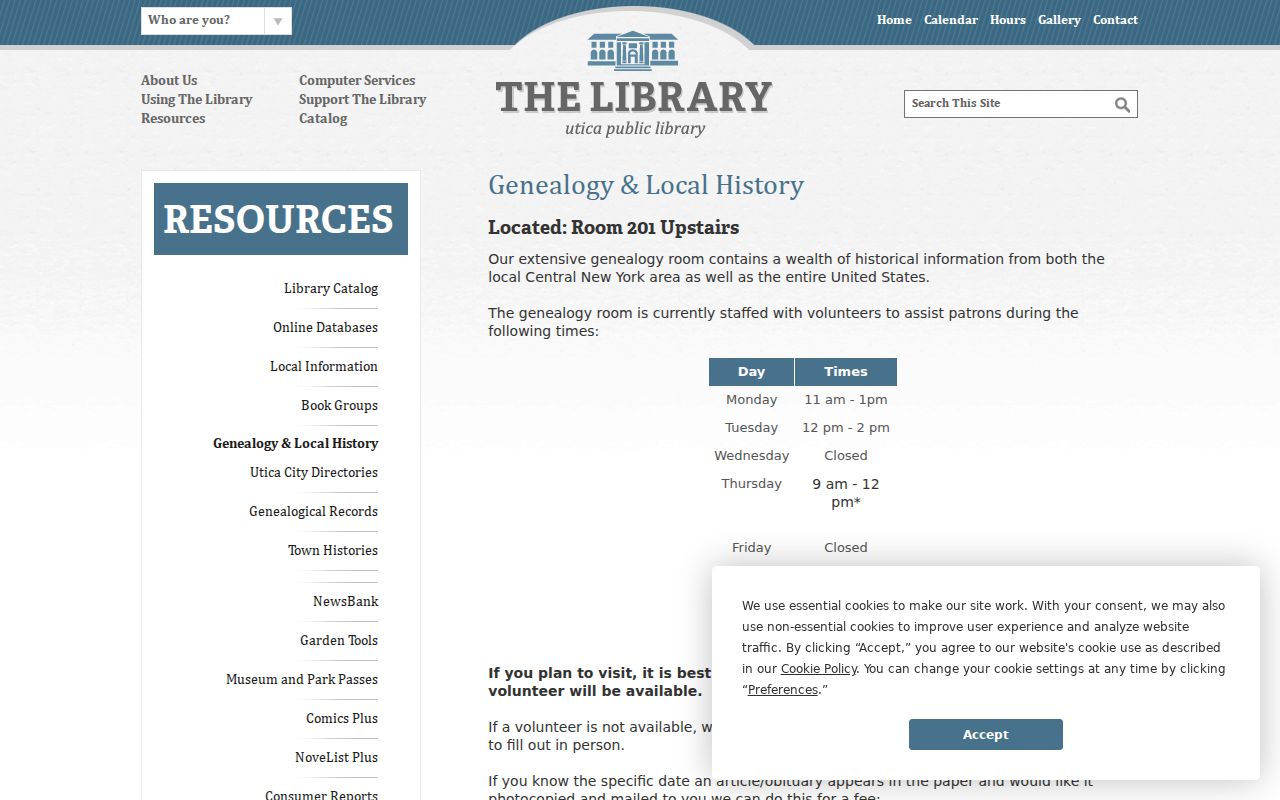
The library combines directory work with census, vital-index, yearbook, cemetery, and newspaper material, which makes it a strong cross-check for a Oneida County household.
Oneida County City Directory Scans and Gaps
The Utica directory collection credits volunteer Karen Dwyer and notes that the online project remains under construction. Use a scan as a volume-specific source. Record its year, page, section, and whether the image is sharp enough to support the transcription. For Oneida County research, a clean image of an abbreviation key may matter as much as the entry itself.
The scanned sequence has breaks around several years. It reaches 1911-17, 1919-21, 1923-24, 1926-28, 1930-33, 1935-43, 1945, 1947-49, and 1951, rather than every year in a continuous line. That pattern supports a careful Oneida County city directory timeline, not a claim of uninterrupted coverage.
Open the digitized directory year list to choose the closest available volume.
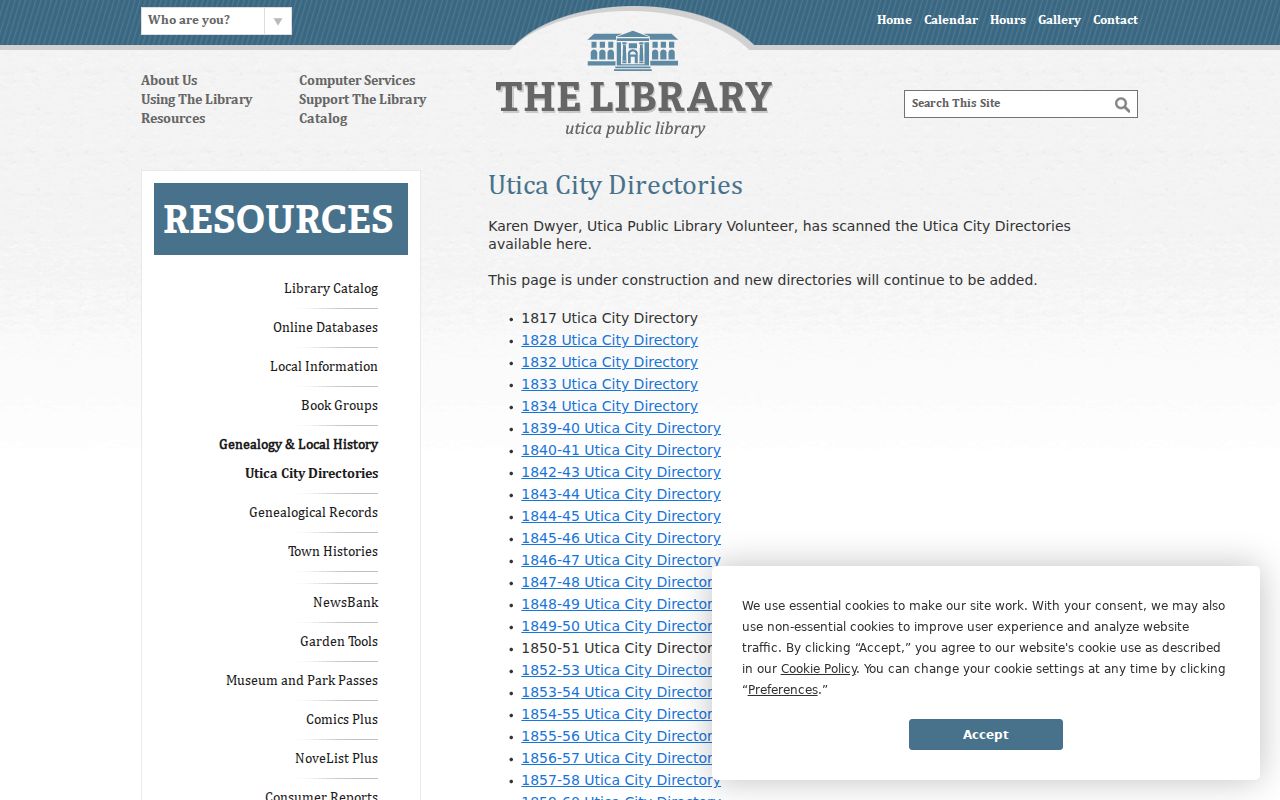
Choosing years on either side of a gap often reveals a move, a changed occupation, or a new widow notation without inventing what the missing volume would have shown.
Note: Keep the original spelling from every Oneida County city directory beside any modernized search spelling.
Oneida County City Directories Beyond Utica
A volume titled Utica may be broader than its title suggests. Many digitized books also include New Hartford, Whitesboro, New York Mills, Yorkville, Oriskany, Deerfield, Clinton, Waterville, Frankfort, Ilion, Mohawk, or Herkimer. That regional reach is especially useful when a Oneida County family seems to vanish from one municipal label. It is also a warning: a city directory entry does not prove that the present legal boundary was the same.
New York State Library broadens the search with its Oneida and Rome microform runs, while the National Archives lists Rome directories for 1929, 1931, and 1934 in its 1930 holdings guide. Search the nearest town and the surrounding communities before concluding a household left Oneida County.
Consult the New York State Library city-directory holdings when a Oneida County city directory scan is not available.
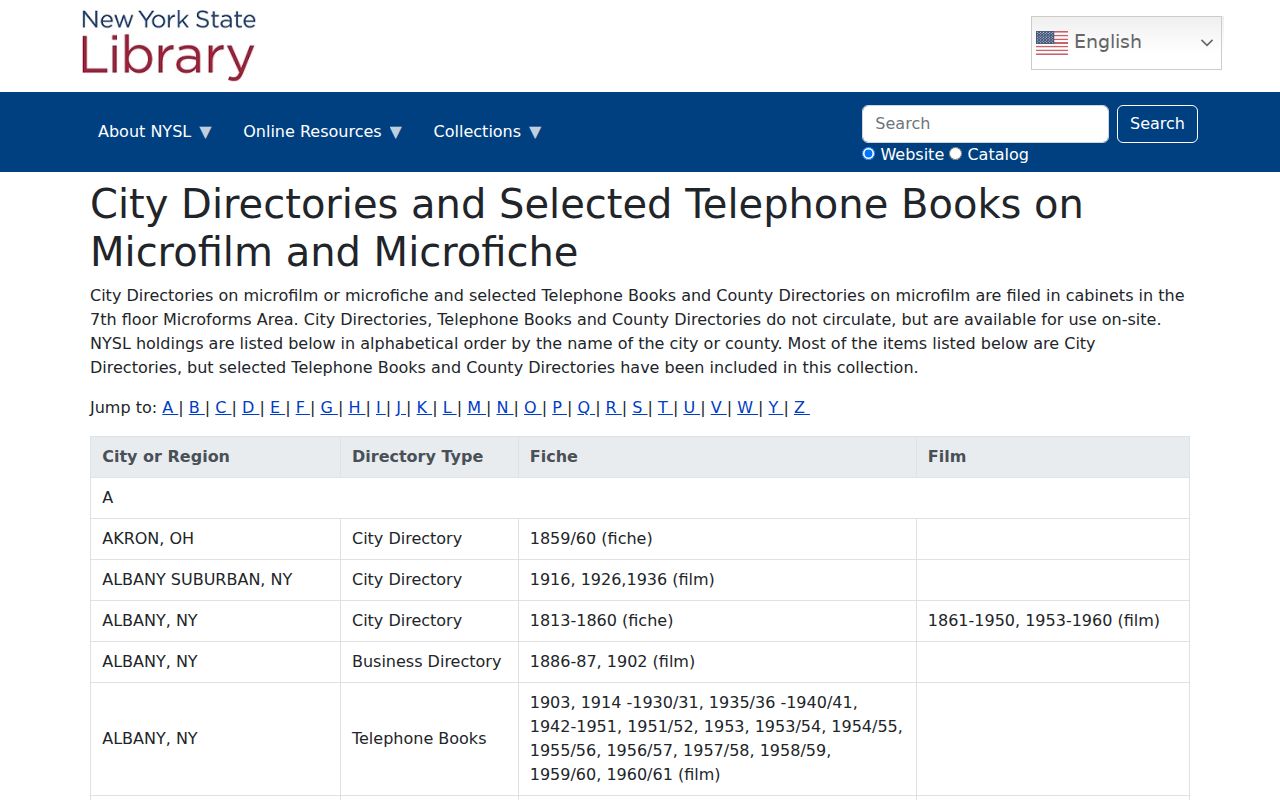
The microform list is a holdings tool, so it identifies where to ask for a volume rather than promising an online page image.
Read Each Oneida County City Directory Entry
Read the introduction and abbreviation key before transcribing a Oneida County city directory entry. Depending on publisher and year, an entry can include a surname, given name, occupation, employer or business, residence, office address, spouse in parentheses, widow notation, and an owner or renter-style mark. The symbols vary by volume. A same-name result at the same street address is a lead, not a proven identity.
| Source citation | Save the volume title, year, page, source link, section, and scan quality. |
|---|---|
| Exact name | Keep the printed spelling, initials, and any variant used in later searches. |
| Work and address | Record occupation or employer, residence, and a separate business address when printed. |
| Household marks | Copy spouse, widow, owner, renter, and abbreviation-key details exactly as the volume defines them. |
- Criss-cross section
- A street-order part of some directories that can place entries by address rather than surname.
- Householder index
- An index focused on household heads, which may omit other people at the address.
- Abbreviation key
- The publisher's explanation of short marks, usually near the front or back of the book.
A Oneida County city directory is an annual snapshot. Compare the occupation, spouse, age, census household, deed owner, and obituary before deciding that two matching names are the same person.
Oneida County City Directory Companions
Room 201 offers more than an old Oneida County city directory. Utica Public Library holds local and family histories, high-school and university yearbooks, cemetery inscriptions, federal census material from 1790-1930, New York census indexes from 1800-1870, and microfiche vital indexes for births 1881-1937 and deaths and marriages 1881-1963. Newspaper microfilm begins in 1825. These are different kinds of evidence, so their dates and purposes should remain separate in a research log.
The library also links New York State Historical Newspapers for the Utica Observer/Daily Observer, Oneida Whig, and Rome Sentinel/Daily Sentinel. Its article or obituary photocopy service is free for Oneida, Herkimer, and Madison County residents, $10 for other New York State residents, and $15 elsewhere in the United States. Ask for a date and page citation.
Check the National Archives 1930 city-directory holdings when a Rome volume is missing from the Oneida County library trail.
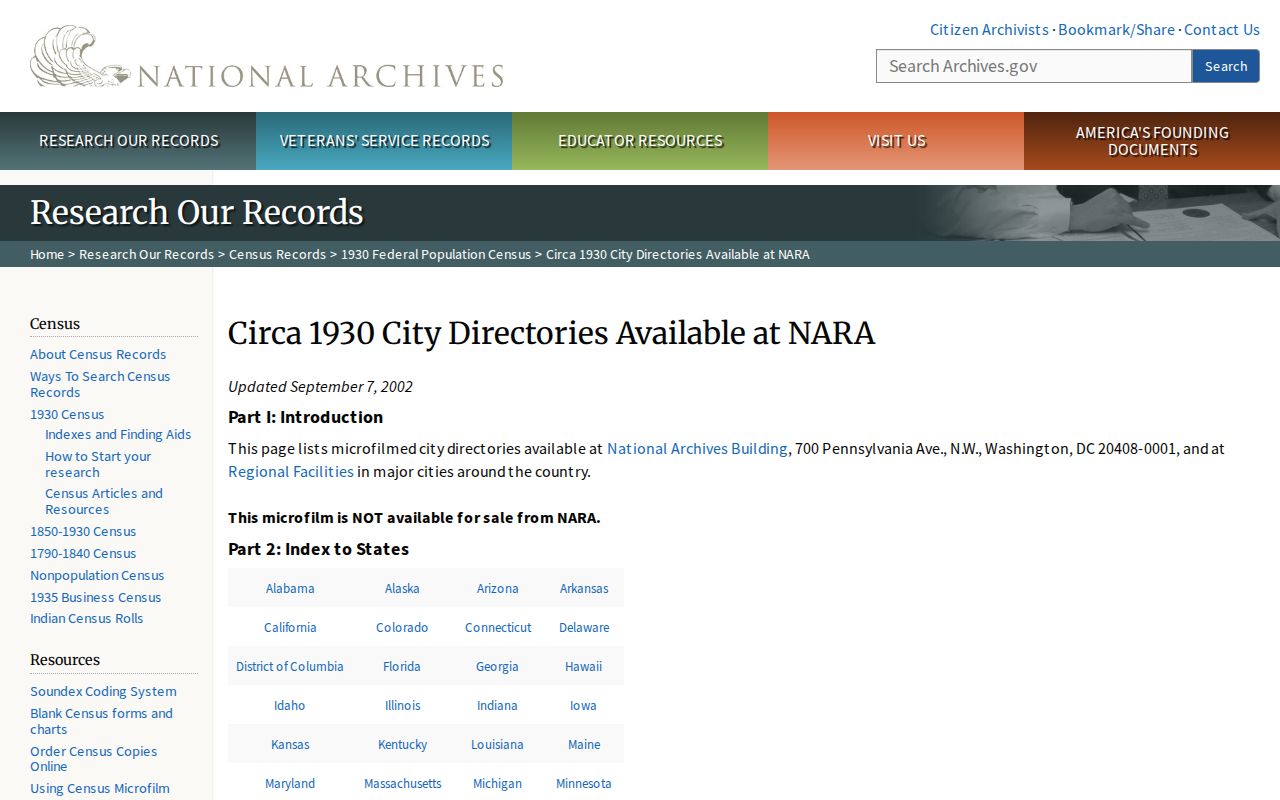
The National Archives list can point a Oneida County researcher toward a Rome volume when the local shelf or scan has a gap.
Trace Oneida County City Directory Households
For family history, begin with the exact name, spelling variants, occupation, and known street. Read the alphabetical portion first, then the street or business section if the volume has one. Oneida County city directories are most useful when every observation is dated and when unavailable years stay visible in the timeline.
- Find the first available Oneida County city directory entry and record its year, page, address, publisher, and section.
- Move volume by volume, noting changes in street number, occupation, spouse, widow, estate, or removal notation.
- Read the street section where available and compare nearby entries without assuming an address section exists every year.
- Pair directory snapshots with released federal census schedules, which add ages and relationships to a more precise address lead.
- Use obituary, probate, cemetery, deed, or another-city evidence to test a disappearance from the Oneida County run.
A directory owner mark is not a deed. Confirm a title question separately and treat a listed business address as distinct from a residence. The related Oneida County previous residents search follows a single address backward through those other records.
Oneida County City Directory Addresses in Context
Old address evidence in Oneida County often follows older transport corridors. Fort Bull and the Oneida Carrying Place predate the county, while the Erie Canal began in Rome in 1817 and later canal, rail, and Union Station corridors reshaped where people worked and lived. An address near a former canal or rail route can now sit in a district, on a renamed street, or on a redeveloped parcel.
Sanborn maps add building context without identifying every resident. Official study material identifies Utica maps for 1884 and Rome maps for 1886, and cites Oneida County sheets from 1852, 1858, 1874, and 1907. The Library of Congress Sanborn collection is a useful starting point for digitized sheets; local repositories may have additional print or microform copies.
Note: Do not convert an old Oneida County street label into a modern parcel match without checking intersections, maps, and legal records.
Oneida County City Directory Research Help
When a Oneida County city directory scan stops, the Oneida County History Center can provide a human research route. Its research library is at 1608 Genesee Street in Utica, requires an appointment, and can investigate holdings or answer genealogy questions for a small prepaid fee. Call 315-735-3642 or email research@oneidacountyhistory.org. No public online name-index inventory or dedicated house-history guide was located, so ask for a collection, date range, record group, and exact page citation.
The County Clerk genealogy route also points researchers toward the Records Center, library, and History Center. Those places complement each other: the clerk supplies deed and mortgage context, the library supplies directories and newspapers, and the History Center may locate family, neighborhood, industrial, church, cemetery, map, or newspaper material.
Review the Oneida County History Center research-library details before arranging a visit.
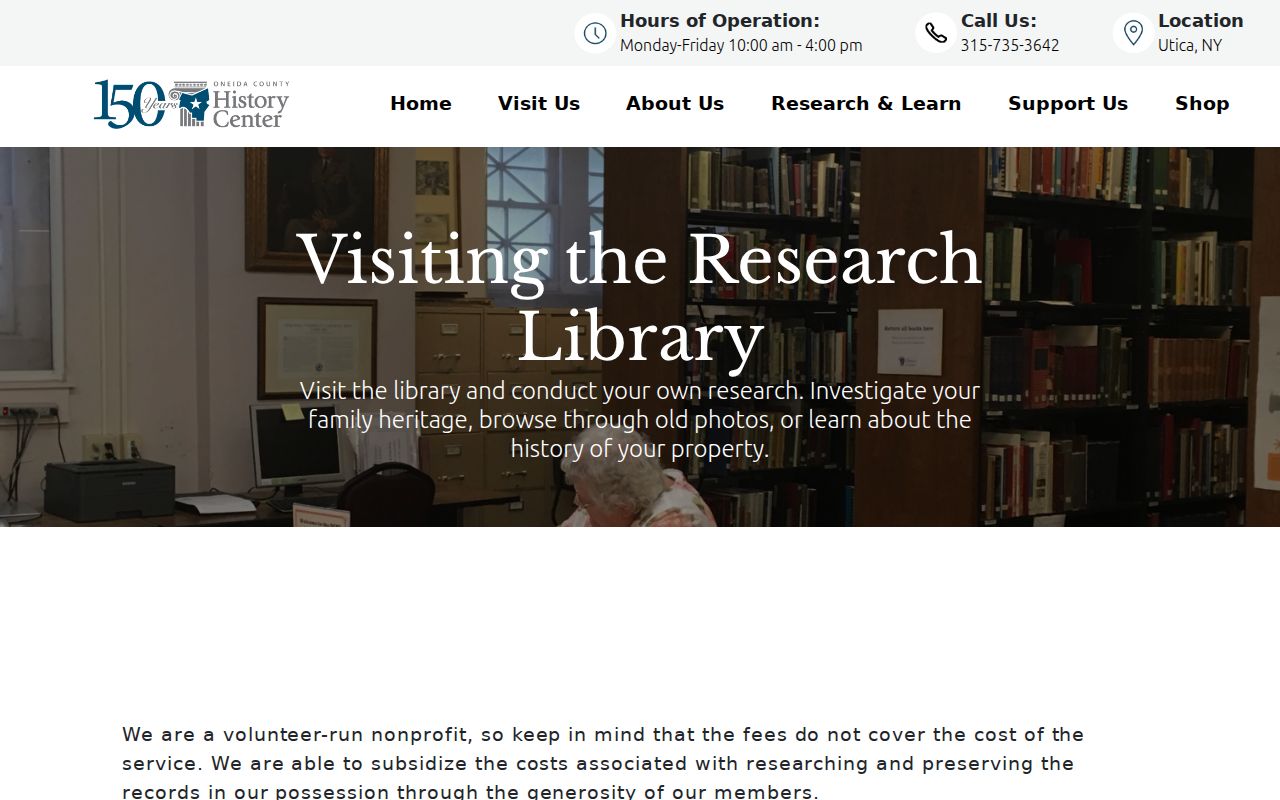
The appointment route is most helpful when a Oneida County city directory citation needs a local collection check beyond the available scans.
Verify Oneida County City Directory Leads
Use the Oneida County city directory as evidence of a dated listing, not a final answer about residence, ownership, or family relationships. A person may have moved, boarded, been omitted, appeared under a variant name, or been listed at a business. Census schedules, deeds, probate, and obituaries test different parts of the story. Keep both the original entry and the later confirmation in the same citation log.
For a Oneida County city directory search, the most reliable conclusion states exactly what the book says, names the volume and page, and explains what another dated record does or does not confirm. That approach preserves useful uncertainty when gaps remain.
Oneida County research is strongest when the library volume, microform reel, map sheet, or Clerk record can be returned to later. A clear citation lets another family member or researcher test the same entry without relying on a copied name alone.