
Oneida County Resident Lookup Coverage
A one-person check works best when the record is chosen for its narrow purpose. The assessment roll identifies the listed owner or taxpayer, the tax mailing address, and the parcel situs. It does not identify every person who lives at that address. Recorded deeds add the parties and legal parcel description. Court and probate indexes supply dated case leads. Vital records, voter status, business filings, and license status each have their own access rules.
| Record | What it can confirm | Oneida County source | Access boundary |
|---|---|---|---|
| Assessment or tax roll | Listed owner or taxpayer, tax mailing address, and situs | Oneida County property database | Public lead, not proof of occupancy |
| Recorded deed | Grantor, grantee, legal description, and recording trail | County Clerk SearchIQS | Index/data from 1963; images generally from 1974 |
| Voter registration | Limited registration and polling information for a named person | New York voter lookup | Not a public full-file search |
| Civil court docket | Public case party, court, filing, and status lead | eCourts, NYSCEF, and County Clerk | Sealed and restricted matters are excluded |
| Vital or probate record | Event or estate lead, heirs, or fiduciary | Registrar, NYS DOH, or WebSurrogate | Eligibility and redaction rules apply |
| Business or license record | Entity, DBA, filing, credential, or status connection | New York DOS or NYSED | Not evidence of a home address |
Use the official Oneida County property database when an address or owner lead is already known. Use SearchIQS when a parcel needs a dated transfer trail. A person with only a name should be tested against more than one independent record before a match is treated as reliable.
Verify Oneida County Resident Records
Common names create the main Oneida County same-name trap. Match at least two independent attributes, such as a municipality and date range, a middle initial and parcel, a relative and probate file, or a filing date and former address. A name plus a ZIP code is not enough. Keep each result dated because a tax roll, deed, or case file describes a point in time rather than a guaranteed current location.
- Start with a name or address in the property database. Save the listed owner or taxpayer, mailing address, situs, municipality, and parcel identifier without calling the owner an occupant.
- Use the New York voter registration lookup only as a named registration and polling lead. Compare spelling, county, and date of birth privately rather than publishing it.
- Check a dated deed, civil case, probate index, or official business filing. Compare the party role and document date with the parcel and name variant.
- Request a copy from the office that keeps the record when the distinction matters. A custodian, not a search result, supplies the authoritative copy or correction process.
- Docket
- A court's running case record, showing filings, events, parties, and status. It is a case trail, not a biography of a person.
- Index and image
- An index is the searchable list of names and record references. An image is the document scan, when public access is available.
- Certified copy
- A copy authenticated by the custodian for a purpose that requires official certification. It is different from an informational image or index hit.
Note: Record the source, date, exact spelling, municipality, and reason for each match so a same-name error can be traced and corrected.
Oneida County Court Lookup Fields
For public civil matters, begin with the Oneida County courts route and use the state systems that fit the case. County Clerk civil index coverage is 1992 to the present. NYSCEF and eCourts can surface a public party or case hit, but a result does not guarantee that a document can be downloaded. A party can be a plaintiff, defendant, attorney, fiduciary, agency, or witness, so a hit alone does not establish Oneida County residence.
| NYSCEF search field | Identity-check use |
|---|---|
| Case identifier | Enter a full case, index, or docket number when known. |
| Attorney or third-party index | Use a file number or third-party index when supplied by a document. |
| Party name | Search business or organization, or first and last name with an optional middle name. |
| County, case type, and date | Narrow the results by county, case type, and filing date range. |
| Tax or SCAR block and lot | Use the dedicated Tax Cert or SCAR controls when the matter is property-related. |
The NYSCEF case-search instructions describe those choices. A result log should retain the case or index number, court and county, case type, parties and roles, filing date, current status or disposition, and whether a public document or image is available. That inventory keeps a docket lead separate from a verified court copy.
The Oneida County court-record access page shows the local clerk route.
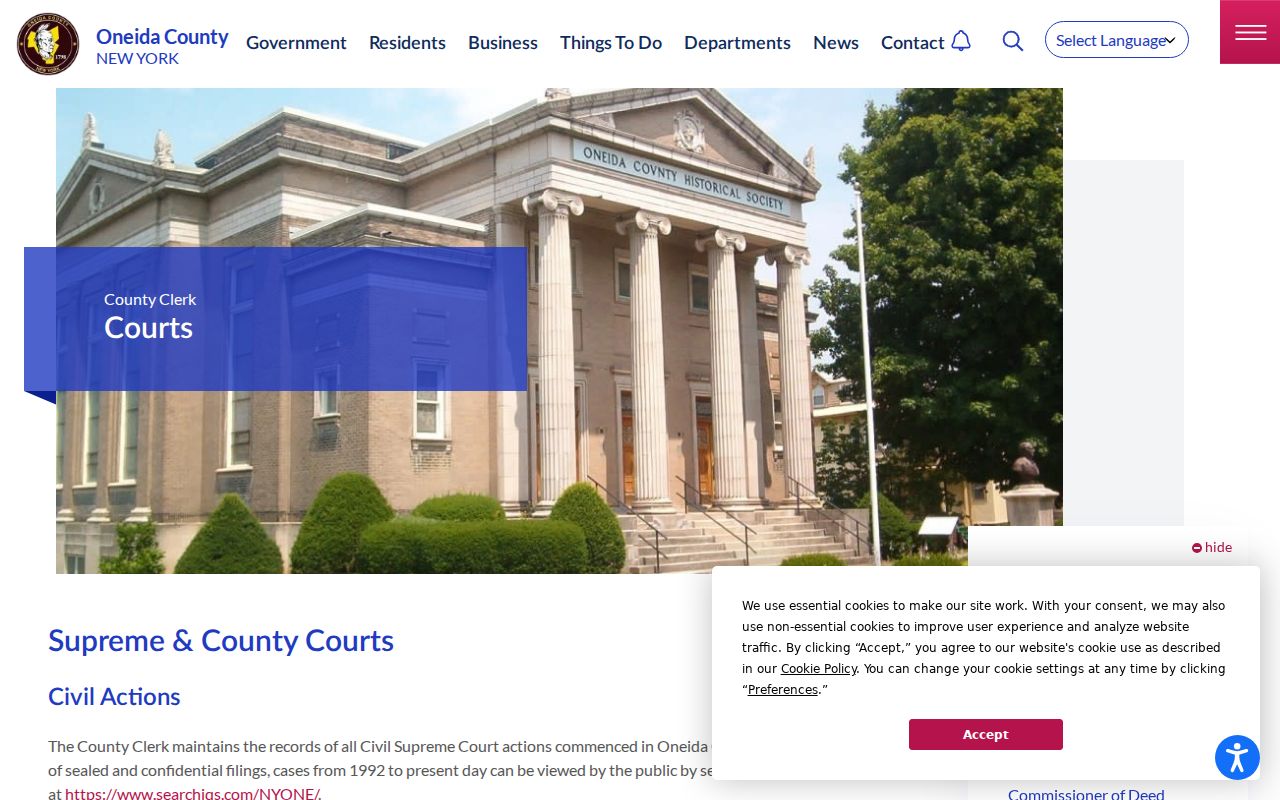
Criminal files are not a public web index in Oneida County. Nonsealed criminal information may be inspected on a County Clerk computer terminal, while a name and timeframe request can take up to 24 hours and copies carry the posted charges.
Oneida County Voter Lookup Limits
The state tool accepts last name, first name, date of birth in MM/DD/YYYY form, county, and ZIP or address-related controls. Its useful result is limited registration or polling information for the named voter. A no-match can reflect a spelling difference, recent move, county choice, list maintenance, or a protected record. It does not prove that the person has never registered.
New York Election Law §3-103(5) restricts voter-registration information to election use, and the state full-file route requires an elections-purpose statement. Ballot choices are not public. Treat a voter hit as one tightly bounded corroborating fact, not a ZIP-wide list or a substitute for parcel and clerk records.
Oneida County Probate Lookup Leads
WebSurrogate offers decedent or party searches, death-date, file, and old-index modes. A probate file can identify an executor, heir, or fiduciary, but an address in that file may belong to an attorney or fiduciary instead of the person being researched. Read the party role, then compare it with a deed from an estate or executor before drawing a family connection.
Older Rome court work needs a separate caution. A courthouse and jail fire occurred there on March 15, 1848, so pre-fire court material may have gaps or reconstructed series. An absent online result is not a clean negative. Ask the clerk, History Center, or county historian about surviving indexes, later references, or archival books.
Oneida County Vital Record Routes
Birth, death, and marriage certificates are not County Clerk records. The event city or town registrar is the local route, while the New York State Vital Records office handles statewide eligible orders. Utica advertises birth and death records from 1876 forward at 1 Kennedy Plaza. Rome advertises records from 1882 forward. Town start dates vary, and early series can be incomplete, so the event place matters.
New York State Vital Records identifies the statewide order route and record boundaries.
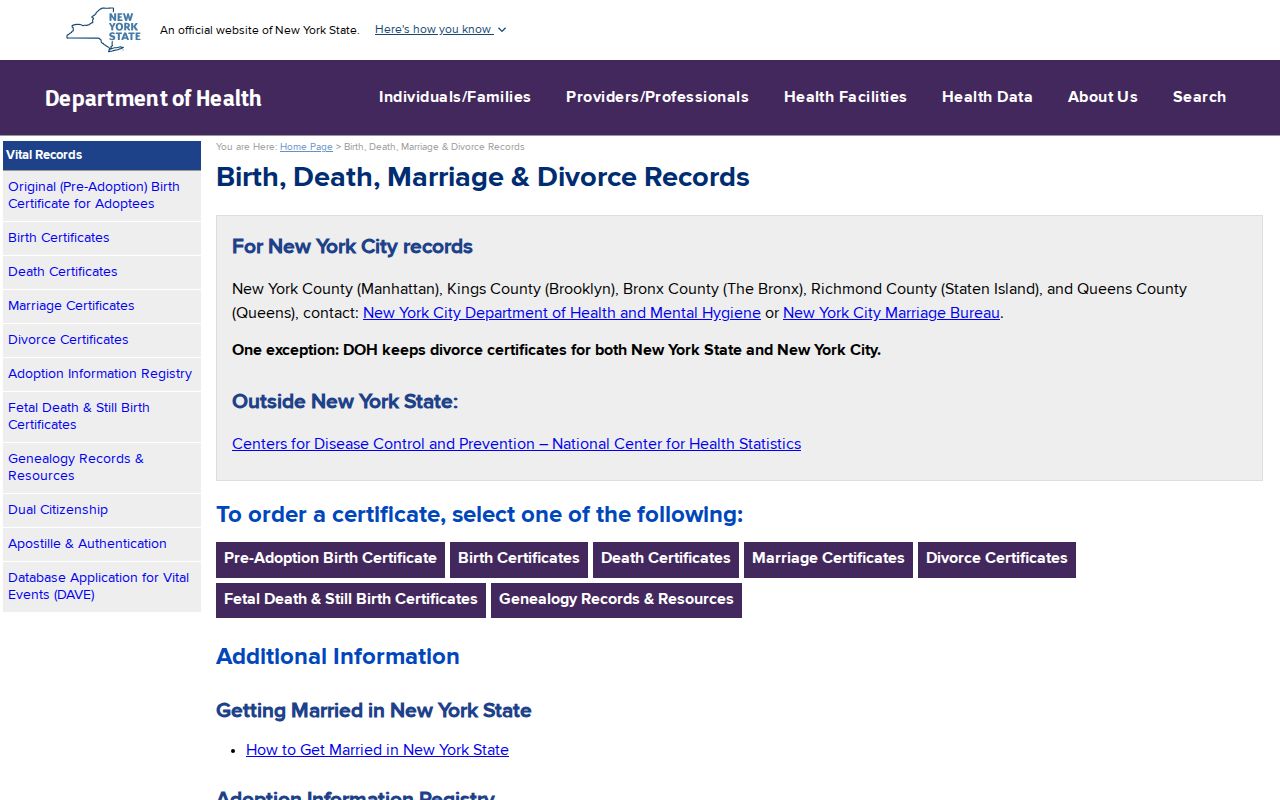
Public Health Law §4174 controls certified-copy eligibility. Outside New York City, current birth, death, marriage, and divorce records are not FOIL records. A current certified request depends on the record type, relationship or authority, identification, and the custodian's process.
For genealogy, the state uses a 75-year birth rule when the person is known deceased, a 50-year death rule, and a 50-year marriage rule when both spouses are known deceased. Direct-line descendants may use relationship and death proof under the stated rules. These are access paths for historical research, not an open current-name index.
Adoption Consent for Oneida Families
The NYS Adoption Information Registry is the official route for eligible adoptees, birth parents, and siblings seeking adoption information. It can provide non-identifying information and may permit identifying exchange when the required people register and consent. It cannot locate a missing person or release sealed original birth or adoption records through a routine name search.
New York's genealogy access instructions explain the separate historical-record route.
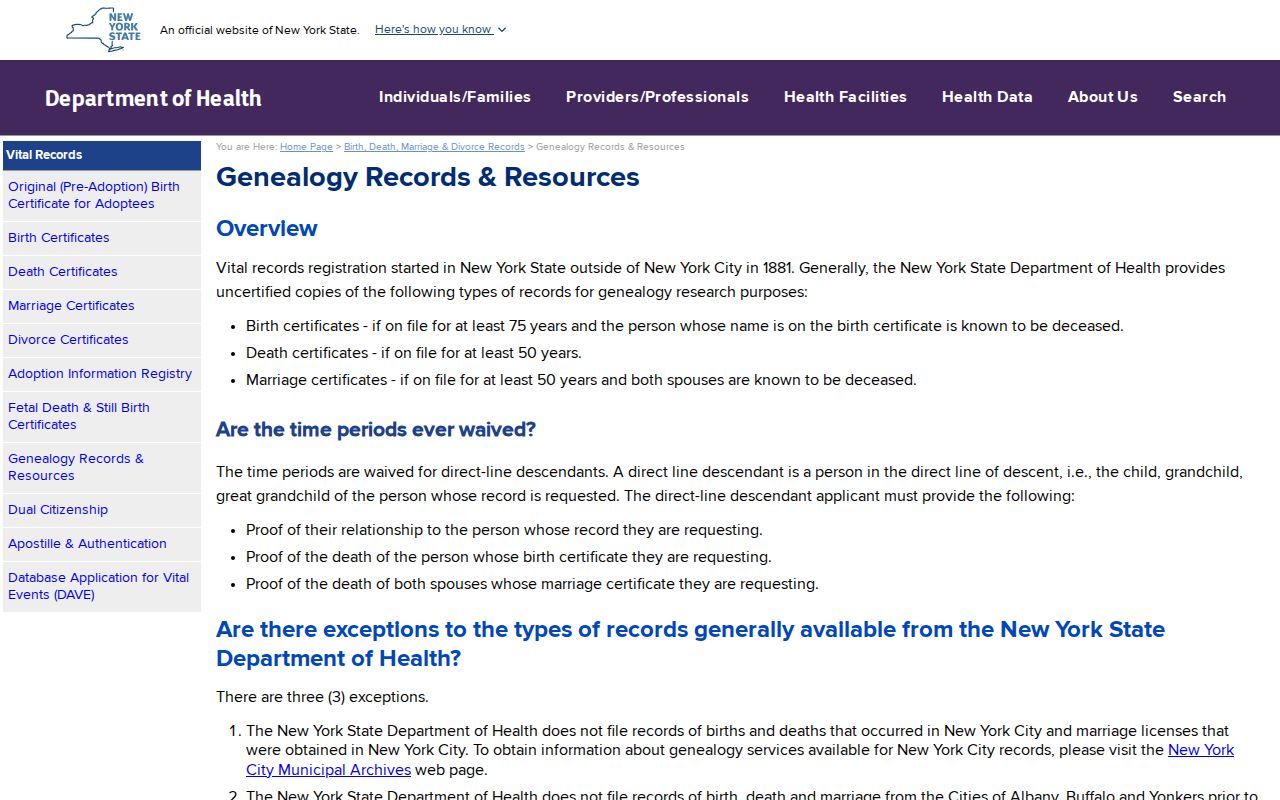
The two paths serve different needs. Genealogy rules govern old eligible vital events, while the registry provides the consent-based process for sealed adoption information.
Oneida County Affiliation Checks
When a name is tied to a public entity or credential, a state business search, County Clerk assumed-name record, or UCC inquiry can provide corroboration. Entity results can show status, organization date, jurisdiction, county, service address, agent, and filing history. A service or principal address is a business contact, not proof of a private residence.
A state credential verification can confirm a profession, license number, location, status, original date, or discipline when its terms permit the search. It excludes private residence fields and should be used as credential evidence only.
Oneida County Record Request Paths
When an index stops, contact the custodian that holds the missing record. County Clerk name searches can be requested for a two-year period at $5, and ordinary copies are generally $.65 per page with a $1.30 minimum. Give the office the record type, names, date span, court or municipality, and whether an informational or certified copy is needed. Older deeds and some images may require an in-office or archival route.
New York FOIL, Public Officers Law Article 6 §§84-90 and §87, reaches existing agency records subject to exemptions. An agency generally acknowledges a request within five business days. FOIL does not require an agency to investigate a person, create a list, or answer a research question. For a vital record, use the registrar or DOH instead.
Oneida County Record Boundaries
Protected addresses and closed records are part of an accurate name check. The New York Address Confidentiality Program supplies a substitute address and protected voter option for qualifying participants. Sealed, juvenile, restricted family, adoption, and protected motor-vehicle information also sit outside an ordinary public name search. Ask the specific custodian about correction, redaction, or safety treatment rather than trying to rebuild restricted information from fragments.
Lawful use. Use Oneida County records for personal, lawful research and verification. Do not use a name, address, or record trail to stalk, harass, intimidate, or endanger another person.