
Oneida County Previous Residents by Record Era
A Oneida County address trail changes by era. Start with today's parcel and purchase deed when the question is recent. Move to local directories, census schedules, maps, and archival books as the trail becomes older. These records answer different questions. A deed tracks transfer of a legal estate, while a directory or census can be a dated lead about people at an address. Keep ownership and occupancy on separate lines.
| Source | Years it covers | Where held | What it shows |
|---|---|---|---|
| County deed index and images | Index/data 1963-present; images generally 1974-present | SearchIQS and County Clerk books/backfile | Parties, recording, legal description, title-chain lead |
| Assessment and tax rolls | Public archive 2021-2026; older municipality files vary | RPTS or municipal assessor | Annual owner, tax address, assessment, class, exemption |
| Utica directories | 1817-1951, with gaps | UPL scans and physical collection | Occupant, occupation, address, household notation |
| Federal census | UPL 1790-1930; national 72-year release rule | Library, NARA, Census sources | Household composition and historical residence |
| Sanborn and county maps | Utica 1884, Rome 1886; cited county sheets 1852, 1858, 1874, 1907 | LOC and local repositories | Building, lot, street, and land-use context |
For Oneida County previous residents, the first record should match the date range being researched. A directory cannot prove a deed transfer, and a current assessment roll cannot fill a nineteenth-century gap.
Anchor Oneida County Previous Residents to a Parcel
Use the official Oneida County property database to begin with the physical, or situs, address and parcel identifier. Capture the current owner, owner mailing address, municipality or SWIS, PIN or print key, property class, and any displayed sale history. A situs address identifies where land sits. A mailing address identifies where tax notices go. Neither alone establishes that every person at either address lived there.
The next task is to connect the street address to the legal description. Oneida County records can use section, block, lot, sub-lot, suffix, map, book, or page references. Save those details before a search is repeated with a historic address form. A split lot, merged parcel, condominium, estate, or entity name can otherwise make a familiar street number look continuous when it is not.
Review the SearchIQS search-screen help before moving from the parcel to the deed index.
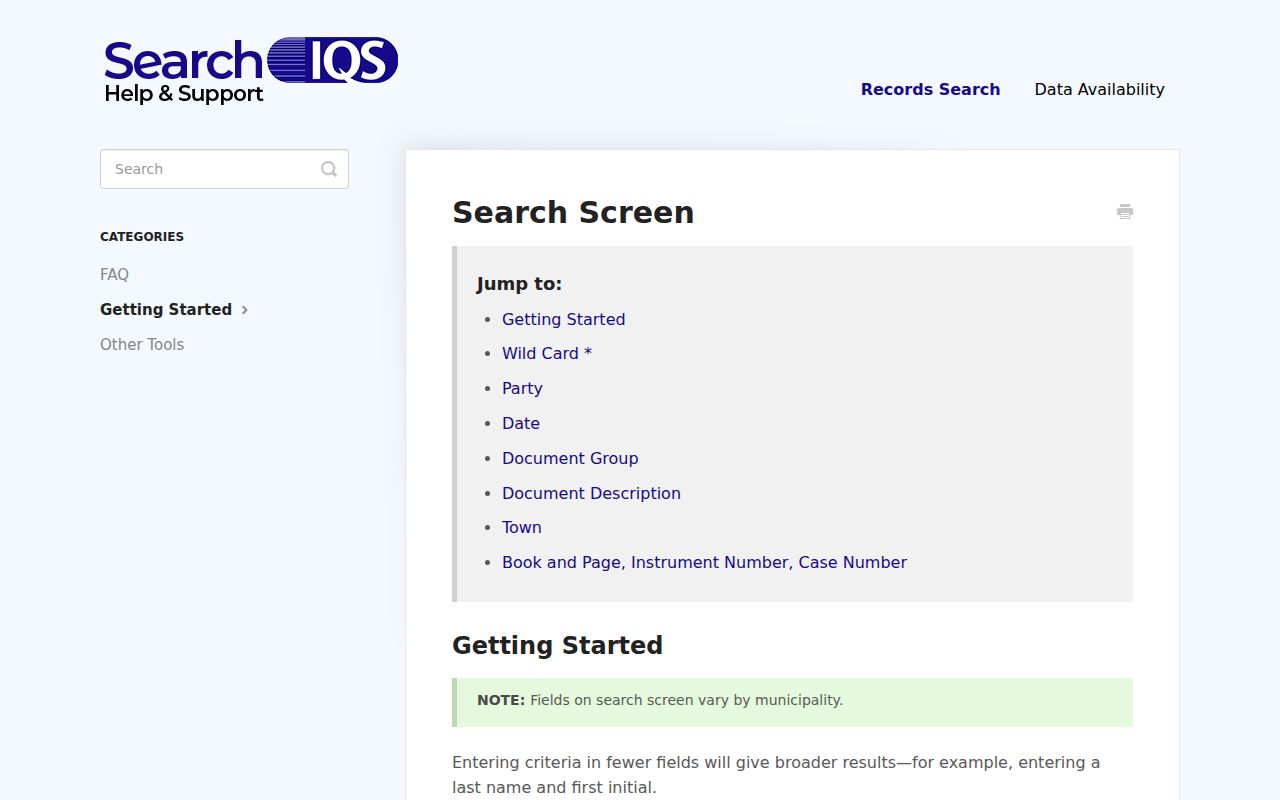
The SearchIQS help illustrates why a Oneida County deed query should be saved with the party role, date range, document type, and recording reference.
Oneida County Previous Residents and Deed Cutovers
The County Clerk's public-record legend creates two important Oneida County cutovers. Deed index/data begins in 1963, while index/image coverage begins in 1974. A result within the earlier period may supply index data but no online image. Before 1963, archival books, microfilm, or a historical search request are the documented route. The research did not locate an exact online sequence for the earlier book room or microfilm reels.
Those limits matter when tracing prior residents. Continuing digitization improves access, but it does not make every old Oneida County page web searchable. A record request should name the person, approximate period, property or legal-description clues, and desired series. Keep a note of where the web trail ended, rather than interpreting an online no-result as a negative finding.
Use the SearchIQS historical index and book guidance to recognize the difference between a current index search and historical materials.
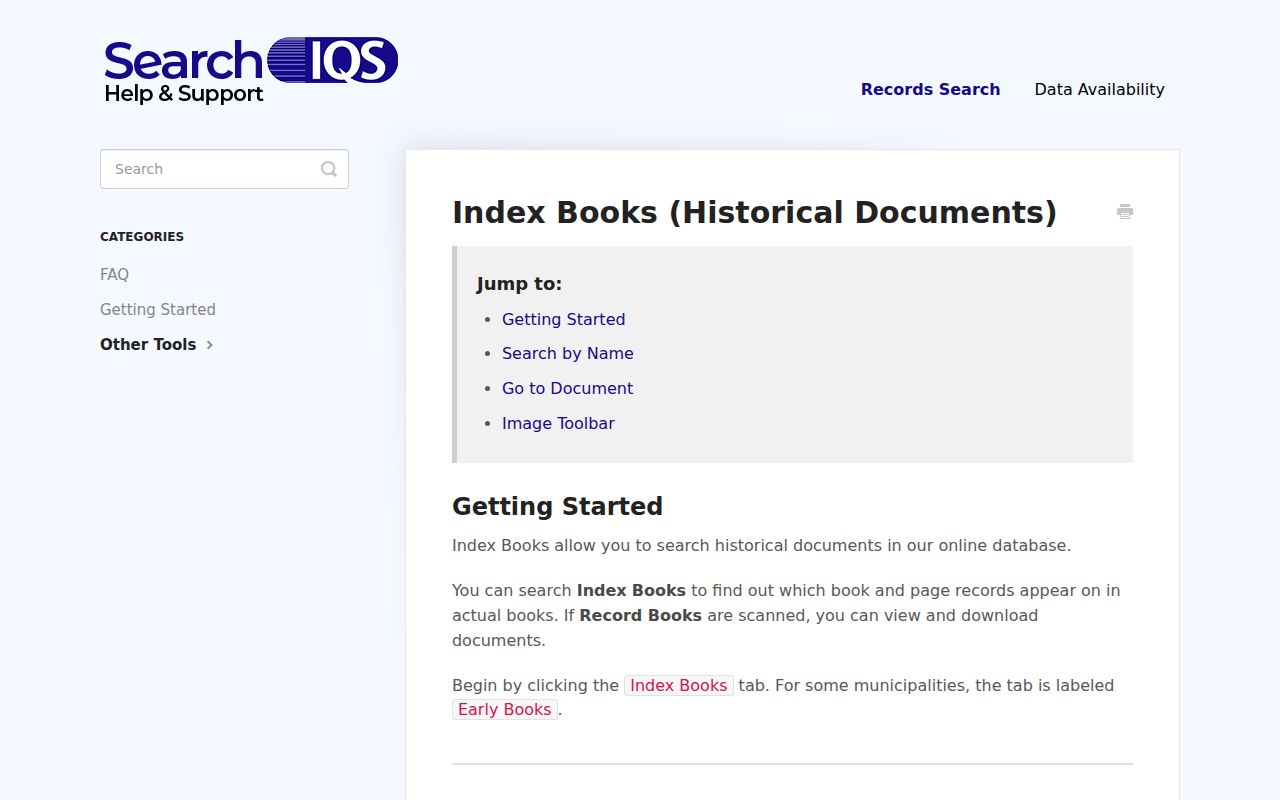
Historical index guidance helps preserve the distinction between a searchable reference entry and the underlying Oneida County record image or book.
Note: Record the online cutoff in the Oneida County evidence log before asking a custodian to check older material.
Trace a Oneida County Deed Chain Backward
Once the parcel is anchored, find the purchase deed in SearchIQS. Take the recording date, grantor, grantee, legal description, liber and page or instrument number, and any stated prior-deed reference. Then search the seller, or grantor, as an earlier grantee. Each link must match the same legal parcel or be flagged as a possible split or merge. That is the reliable route from a present parcel toward past owners.
- Open the current Oneida County parcel record and retain the situs, PIN, municipality, and legal-description clues.
- Search the current owner as grantee for the purchase deed and copy its recording details.
- Search that seller as a grantee at an earlier date, then compare legal description and map references.
- Repeat one transfer at a time, noting estate, referee, entity, or larger-tract deeds that need extra checking.
- When the chain reaches the online limit, request the relevant archival book or microfilm search from the County Clerk.
- Grantor
- The person or entity transferring an interest in the recorded deed.
- Grantee
- The person or entity receiving that interest in the recorded deed.
- Chain of title
- The dated sequence of recorded transfers associated with a parcel.
- Legal description
- The lot, metes-and-bounds, map, or other land description that is more durable than an address.
Mortgages, liens, maps, and judgments may provide clues but are not ownership transfers by themselves. A Oneida County previous residents conclusion should say whether it rests on a deed, an address listing, or another kind of record.
Oneida County Previous Residents in Directories and Census
Deeds answer who transferred a property, not necessarily who lived there. For past households, compare local city directories with federal census schedules. UPL holds federal census material through 1930, while federal releases follow the 72-year rule. The library's Utica directories span 1817-1951 with gaps, and New York State Library adds Utica, Rome, and Oneida microform runs. The directory collections themselves are detailed on the Oneida County city directory page.
Use a simple paired process: directory year and page, then census year and household, then the next available directory. Compare name spelling, age, occupation, spouse, street, and municipality. A different street number can reflect a move, a renumbering, boarding, seasonal residence, or a different person. Preserve the disagreement until another dated record explains it.
See the County Clerk genealogy resources for the local route to directories, newspapers, deeds, and related materials.
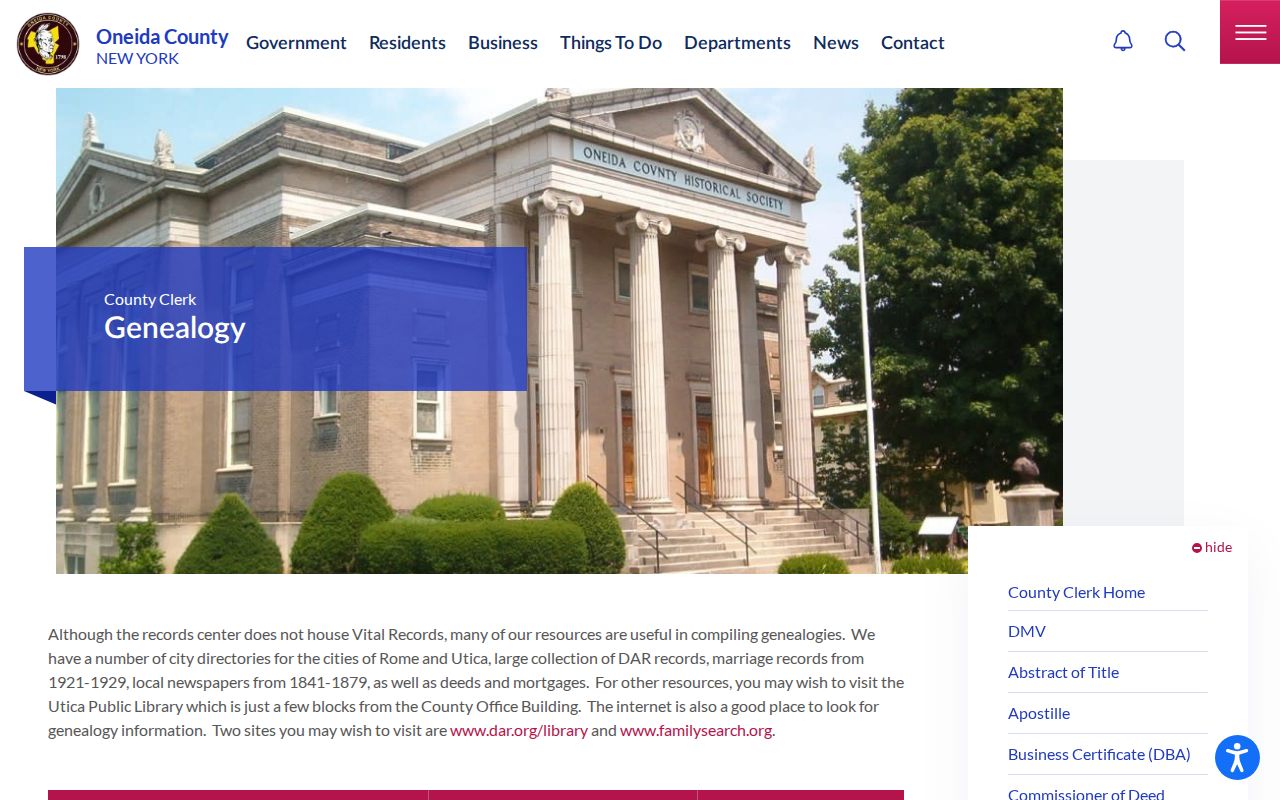
The County Clerk referral route connects Oneida County property research with library and History Center collections rather than presenting a single house-history index.
Oneida County Previous Residents and Building Context
Sanborn sheets can place an address in physical context. The documented local examples are Utica in 1884 and Rome in 1886, with cited Oneida County sheets from 1852, 1858, 1874, and 1907. A map can show a building footprint, lot, street form, or use at the time. It cannot prove a person lived there. Pair a map with a directory, deed, or census instead of treating it as a household record.
Oneida County address evidence also follows a changing transportation landscape. Fort Bull, the Oneida Carrying Place, Erie Canal construction in Rome, railroads, Union Station, and later corridors help explain why an old industrial or canal-side address may now carry a different setting. They do not by themselves resolve a parcel match.
Use the Library of Congress Sanborn collection for available map sheets and request local holdings when a sheet is not online.
Bridge Oneida County Previous Residents Carefully
No countywide authoritative, year-by-year list of Oneida County street renumbering or renaming was located. That makes address continuity a research question, not an assumption. Utica, Rome, villages, and towns can share street names, and old municipal boundaries may not match a current postal label. Compare the old number with intersections, the directory street section, tax PIN, legal description, historic map, and current USPS address validation.
Keep four lines in the address log: historic or current situs, tax mailing address, postal city and ZIP, and legal description or PIN. A postal city, tax municipality, village, and census place can label the same physical Oneida County location differently. Mark each connection as same legal parcel, split or merge possible, or not established.
Note: A familiar street name is not enough to join two Oneida County records without a municipality and dated parcel evidence.
Request Oneida County Previous Residents Records
For an older conveyance or a missing image, the County Clerk offers an archival fallback. The office is at 800 Park Avenue in Utica, with public computer and archival-book access free Monday through Friday from 8:30 to 4:15. A mailed search request costs $5 per name for each two-year period. Copies cost $.65 per page, with a $1.30 minimum. Those details make a narrow date range and complete party name worth gathering before a request.
Use the County Clerk search-records request information when an office search is needed.
The request path gives a Oneida County researcher an alternative when a historical deed or book has not been digitized.
For a known document, the County Clerk copy-request route can be more precise than a broad name search.
Requesting a cited book, page, or instrument supports a stronger chain than relying on an uncited result summary.
Oneida County Past Households and Endpoints
Obituaries and probate records can close a Oneida County address trail, but they answer different questions. An obituary may state a former street, relatives, funeral home, occupation, or date. Probate may identify an executor, heirs, and a later mailing address. Pair either source with the deed or Surrogate file and distinguish an heir's later address from ownership of the historic property. UPL newspaper microfilm begins in 1825, and the History Center can help with local collection questions by appointment.
Utility customer files are generally private, so they are not a substitute for public address research. A municipal permit, planning, code, assessment, or historic-district file may date construction, alteration, or conversion if it survives, but an applicant is not automatically the owner at completion.
Lawful use. Oneida County house-history research belongs to family history, estate matters, civic curiosity, and personal reference. Do not use a record trail to stalk, harass, or harm any living person.